What the Dental R.A.T. Does

The Dental R.A.T. (Remote Access Terminal) is a foot-operated mouse that gives hands-free access to periodontal charting, intraoral cameras and digital X-rays. It needs no additional software. You plug it into a USB port and it works with your current dental software. The 2.0 model can be wireless or wired.

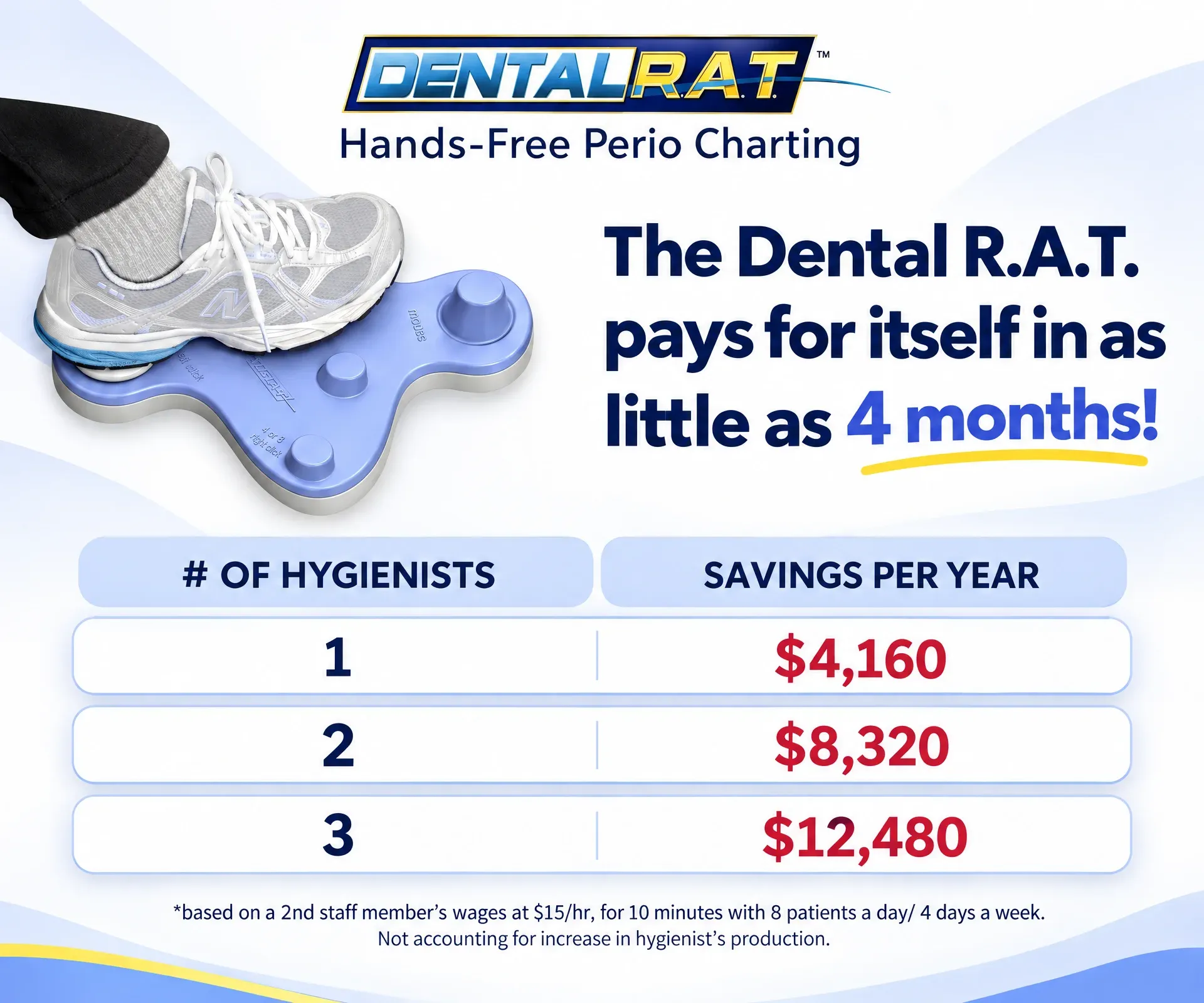
Foot in a sneaker pressing a blue hands-free dental charting pedal, beside a table of yearly savings for 1 to 3 hygienists.

Because the clinician controls the computer with the foot, the hands stay on the probe and the patient. The assistant no longer has to sit in the operatory just to record numbers.

Four Ways the Dental R.A.T. Pays for Itself

One person does a job that used to take two

The most direct return is labor. Charting traditionally ties up a second staff member for the length of the exam. With the Dental R.A.T., the hygienist or dentist charts alone. On the FAQ page, the company notes that charting takes about the same time as it does with an assistant, but the assistant does not need to be in the room at all. The saving comes from reassigning the second person, not from charting faster.

Michelle Heil, RDH, described the effect on her office. The staff felt a welcome drop in stress because assistants were no longer pulled in many directions.

Recorded depths support accurate billing for periodontal maintenance

Periodontal maintenance appointments depend on documented periodontal status. When probing depths are recorded consistently, the visit is supported by the clinical record. When charting is skipped or abbreviated because no one is free to assist, that record has gaps. A tool that makes charting easy to do alone makes it easier to chart every time.

A full chart can often be billed to insurance

A complete, accurate perio chart is also documentation that can often be billed out to insurance. Payers commonly ask for probing depths when reviewing periodontal claims, so a chart that is complete at each visit is easier to defend. The Dental R.A.T. makes that complete chart practical in every hygiene operatory.

Accurate documentation at every appointment avoids legal ramifications

Periodontal disease is a recurring subject in dental negligence claims. Commonly cited problems include failure to diagnose, failure to treat, and failure to inform the patient of periodontal disease. The usual defense is a contemporaneous record showing that the condition was measured, noted and communicated. Charting at every appointment builds that record. The existing page points to published literature on this subject, including pieces on the top reasons hygienists are sued, dental negligence, failure to diagnose and treat periodontal disease, and the pitfalls and strategies around it.

Why Alternatives Often Fail to Deliver the Same Return

Dr. Gordon Christensen reviewed dental software programs in the February 2003 edition of CRA. His independent research found that the top concern with all of the top eight packages was that they did not reduce staff costs. One of the most desired features was hands-free periodontal charting. Software alone moves the data into a computer, but it does not free the person who has to enter it.

Clinicians who tried the common alternatives have reported the same limits:

  • Voice-activated charting:Dr. Keith Asarkof called it extremely finicky, and said it eventually failed altogether. Michelle Heil, RDH, found that it produced many errors. Busy operatories are noisy, and recognition engines are sensitive to that.
  • Automated periodontal probes:Dr. Asarkof found them too complex for his needs and extremely expensive.
  • Pulling a team member in:this is the hidden cost. Each charting session removes someone from other productive work, and Dr. Asarkof said it created stress in the practice.

The Dental R.A.T. avoids these issues. It does not depend on speech recognition, and it does not require a software license or a hardware overhaul.

Costs That Stay Low

Return on investment depends on what you spend as well as what you save. The Dental R.A.T. is plug-and-play, with no monthly fees and no expensive software or hardware upgrades. It runs the software you already own, including Dentrix, Eaglesoft, PracticeWorks, Softdent, PerioExec, Open Dental and MacPractice. It can be running with minimal technical skill. The company states that over its lifetime the device can save tens of thousands of dollars. Warranty options are available for long-term peace of mind.

Benefits Beyond the Chart

The same foot mouse opens, closes and zooms digital X-rays and pictures, and runs intraoral cameras. Dr. Scott Wright reported that three terminals in his office freed up staff for more productive use of their time. He also noted that patients appreciated the technology and knew they were receiving better care and more timely follow-ups. Every task that no longer needs an extra pair of hands adds to the payback.

See Your Own Numbers

The site provides an ROI calculator so you can see how the Dental R.A.T. pays for itself in your own practice. Free demos are available. For more information, call 877-278-0061, Monday through Friday, 9am to 5pm, or email bky.logue@gmail.com.

How does the Dental R.A.T. allow one person to do a job that used to take two?

Traditional charting needs one person to probe and another to record, or one person alternating between the two. The Dental R.A.T. lets the probing clinician enter every value with the foot, so the second person is no longer needed for data entry. The time to chart stays about the same, but the second person is free for other work.

Where does the return on investment come from?

The return has several sources. Labor is freed because charting no longer needs a second person. Recorded periodontal depths support accurate billing for periodontal maintenance. A full perio chart can often be billed to insurance. Complete documentation at every appointment also helps avoid legal problems.

How do recorded probing depths support billing for periodontal maintenance?

Periodontal maintenance is justified by the patient's documented periodontal condition. If probing depths are recorded at each visit, the clinical record supports the service provided. Charting alone with the Dental R.A.T. makes it practical to record those depths consistently rather than only when a second person is available.

Can a complete perio chart really be billed to insurance?

A full, accurate perio chart is documentation that can often be billed out to insurance. Coverage depends on each plan and on the procedure, so check the payer's requirements. A complete chart gives you the clinical evidence that payers typically ask for.

How does charting at every appointment reduce legal risk?

Negligence claims involving periodontal disease often turn on whether the condition was diagnosed, treated and communicated to the patient. A dated chart showing measurements at each visit is the strongest evidence that it was. The Dental R.A.T. makes it easier to chart every time, so the record has no gaps.

What costs should I budget for besides the device itself?

The company describes the Dental R.A.T. as plug-and-play with no monthly fees, and it works with your current software. You do not need to buy new charting software or upgrade hardware. Optional extended warranty coverage is available for purchase.

How should I use the ROI calculator?

The ROI calculator on the Dental R.A.T. site shows how the device pays for itself. For the most meaningful result, enter figures from your own office, such as the staff time currently spent on charting and the number of hygiene operatories. If you want help interpreting the result, call 877-278-0061.

What can the freed-up assistant do instead?

Once the assistant is no longer needed for charting, that time can go to other clinical and office tasks. Dr. Scott Wright reported that his terminals freed up staff for more productive use of their time. Michelle Heil, RDH, saw less stress because assistants were not pulled in many directions.

How many operatories should I equip to see a payback?

The company's materials do not set a required number. One practice with three terminals reported that they freed up staff for more productive work. Michelle Heil, RDH, recommended adding the Dental R.A.T. to each hygiene operatory. The best number depends on how many chairs chart at the same time and how often an assistant is currently pulled in.

Is hands-free charting a better investment than adding staff time?

Adding staff time raises payroll and takes the person away from other work. The Dental R.A.T. is a one-time purchase with no monthly fees. It lets the clinician chart alone while keeping the benefits of audio readback and an accurate record. The company states that it can save tens of thousands of dollars over its lifetime.

Related pages